

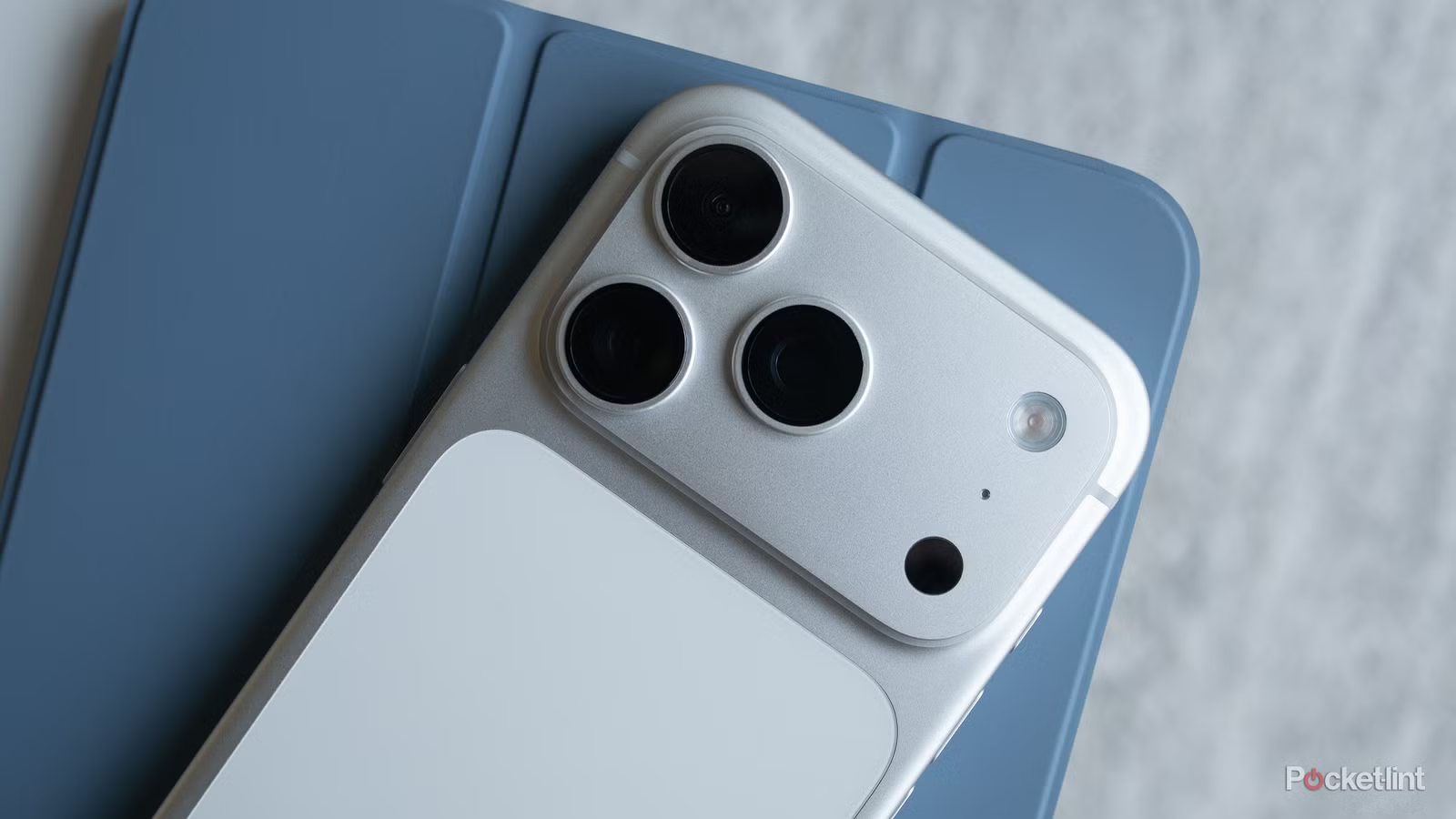
One of the biggest questions that iPhone enthusiasts will always ask when a new iPhone hits the market is how good the camera will be this time. New models of the iPhone will always be compared with their predecessors, and their camera is just one of the aspects that will be scrutinised. And that is what we’ll talk about in this article: how the camera of the iPhone 17 Pro will serve pro photographers.
The Superior Camera
The advanced camera that the Apple iPhone 17 Pro is the most powerful of all the iPhones that have come over the years: 48 MP main camera and 18 MP front camera. Equipped with a wide, ultra-wide, and a telephoto lens and an 8x telephoto lens, this phone would be a dream come true for professional photographers.
The sensors have been upgraded to capture sharper images in low-light conditions.
Focal Lengths You Can Compose With
People ask how many megapixels they can rely on. On the iPhone 17 Pro, you get optics-first range that covers documentary, portrait, and product work without moving your feet. The three 48 MP rear cameras, which the iPhone 17 Pro Max also has, keep detail consistent as you move from ultra-wide to long tele.
Importantly, Apple adds optical quality 8x reach (200 mm). This opens credible headshots from the pit, runway compression, and distant ceremony details, straight from a phone.
Lens Map (35 mm equivalent) and best uses
| Lens/Zoom | Approx. Focal Length | What It’s Best at |
| Ultra-wide 0.5x | 13 mm | Interiors, dramatic foregrounds, and establishing frames |
| Main 1x | 24 mm | General photography and low-light photos |
| 2x Optical-Quality | 48 mm | Classic portrait field of view, tighter street frames |
| 4x Telephoto (Teletrapism) | 100 mm | Stage, runway, and flattering compression |
| 8x Optical Quality | 200 mm | Ceremonies and sports from the sidelines |
Pro Files and Colour that Hold up in Post
If you deliver for print or grade in Lightroom/Photoshop, shoot Pro/RAW (DNG) for controllable highlights and honest skin tones. For motion, the iPhone 17 Pro and the iPhone 17 Pro Max add a leap: ProRes RAW, Apple Log 2, ACES colour, open-gate capture, and even genlock/timecode support in the new pipeline.
Pair with ProRes up to 4K/120 to external storage, and you’re operating inside broadcast-friendly workflows right on a phone.
Speed to the Shot
Two hardware helpers matter here: the dedicated Camera Control button and the Action Button. The former drops you into the viewfinder and lets you thumb exposure, depth, and zoom with haptic precision; the latter, or the Action Button, is your customizable one-press shortcut (for example, launching your preferred pro camera app).
Tethering, Transfer, and External Capture
The USB-C port supports USB 3 (up to 10 GB/s), which makes offloads to SSDs remarkably fast and enables sustained external drive recording when capturing ProRes/ProRes RAW at higher bitrates. On a studio set, the bandwidth shrinks turnaround time for client reviews and keeps your mobile working like a small cinema camera.
Battery, Screen, and the iPhone 17 Design
Long days aren’t a problem for the iPhone 17 Pro. Official figures rate the iPhone Pro for up to 33 hours of video playback and the Pro Max for up to 39 hours; both reach 50% charge in about 20 minutes with Apple’s 40W adapter.
The 6.3-inch/6.9-inch Super Retina XDR panels hit 3,000 nits outdoors and add an anti-reflective coating to make it easy for you to check focus and contrast at noon without a hood.
The iPhone 17 design includes the heat-forged aluminium antibody and vapor-chamber cooling that boost performance. These are useful when you’re shooting RAW bursts or long clips, giving you cooler internals and faster resets.
Which Model Should a Pro Photographer Pick?
| Feature | iPhone 17 | iPhone 17 Pro | iPhone 17 Pro Max |
| Rear Cameras | Dual 48 MP (Main + ultra-wide) | Triple 48 MP (Main + Ultra-wide + Telephoto) | Triple 48 MP (Main + Ultra-wide + Telephoto) |
| Longest Optical-Quality Reach | 2x or 52 mm | 8x or 200 mm | 8x or 200 mm |
| Pro-Formats (Motion) | HEVC/H.264 (no ProRes RAW/Log 2) | ProRes/ ProRes RAW / Apple Log 2 / open-gate | ProRes/ ProRes RAW / Apple Log 2 / open-gate |
| Display | 6.3 inches, 120 Hz, up to 3,000 nits | 6.3 inches, 120 Hz, up to 3,000 nits | 6.3 inches, 120 Hz, up to 3,000 nits |
| Battery (Video Playback) | Up to 30 hours | Up to 33 hours | Up to 39 hours |
Real-World Gain for Stills
- Low-Light Sharpness: Bigger and stabilised sensors plus Deep Fusion and Smart HDR 5 keep the texture honest without over-smoothening; switch to 48 MP when you crop.
- Portrait Control: ‘Next-gen portraits” keep Focus and Depth editable afterwards, cutting reshoots for small resets.
- Colour-Managed Handoff: Apple Log 2 + ACES lets motion clips match your stills grade across deliverables.
On-Set Quality of Life
- The open-gate means one take can feed 16:9 and 9:16, which is useful for campaigns needing horizontal and vertical. Lock WB and use a 180-degree shutter rule for continuity.
- Genlock/timecode support (with Blackmagic’s ProDock) brings multi-cam-sync and LED-wall compatibility. This is handy for hybrid shoots or virtual production.
- The 3,000-nit, anti-reflective ProMotion panels are bright and smooth enough to judge focus by eye, even in hard sun.
Conclusion
For working photographers, the iPhone 17 Pro is the first one that behaves like a real, always-with-you camera system. Optics over 13-200 mm with optical-quality fidelity; stills are ProRaw; motion is ProRes/ProRes RAW in Apple Log 2, with open-gate and ACES for colour-managed deliver. Add Camera Control, USB 3 transfers, and the tougher iPhone 17 design, and you have your very own pocket camera.